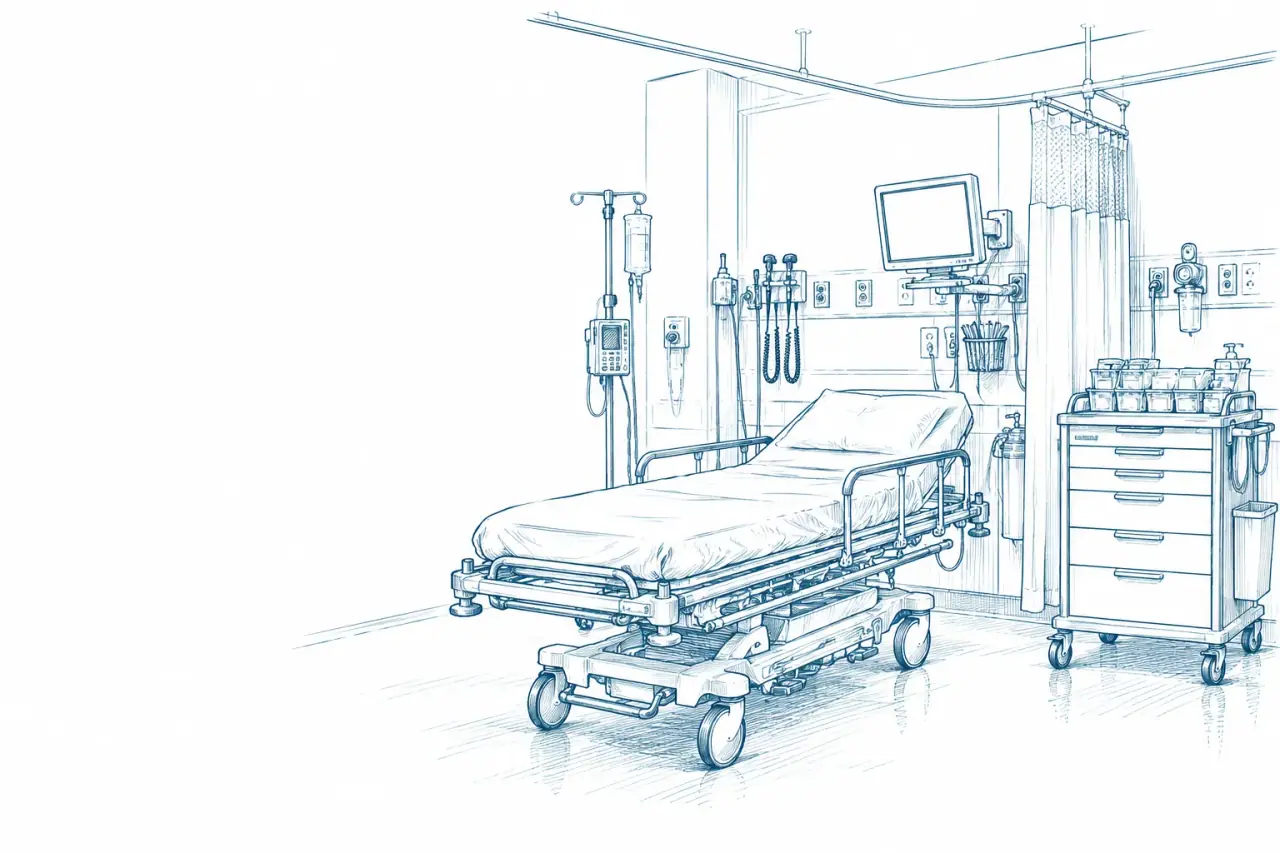
AI medical interpreter for emergency medicine
Opalite starts real-time interpretation in the emergency department in 150+ languages and dialects with no wait, from triage onward.
Today's challenge
What gets in the way of interpretation in the emergency department today
Triage waits on a phone line
The triage nurse waits in the phone interpreter queue with a febrile toddler's parents at the window.
A husband interpreting chest pain
A husband interpreting in the bay can soften or skip key details of his wife's chest pain.
Typing the history mid-conversation
The emergency physician types the interpreted history into the ED note instead of watching the patient's grimace.
Cost of inaction
Language interpretation remains a gap in emergency medicine
Meet Opalite.
Real-time AI medical interpretation in 150+ languages and dialects, connecting providers and patients in seconds.
- Works on the devices care teams already carry: phones, tablets, computers, and telehealth platforms
- Integrates with all EHRs
- Built for HIPAA-compliant healthcare
- SOC 2 Type II attested security controls
Workflow
How Opalite fits the ED visit
Arrival and triage
Chief complaint, onset, allergies, vital signs
Interpretation on the triage phone, tablet or workstation, with no wait
Physician evaluation
History, exam, differential, test plan
Guardian checks every sentence in real time and re-translates on any quality slip
Results and decisions
Imaging, admission or discharge discussion
Guardian is designed to keep a missed "no" or "not" from flipping an admit or go-home decision
Clinical use cases
Interpret the conversations that matter most
Last known well
EnglishWhen was the last time you saw her completely normal, this morning or last night?
Spanish¿Cuándo fue la última vez que la vio completamente normal, esta mañana o anoche?
Allergies
Chinese (Mandarin)青霉素只是让我胃不舒服。做检查用的造影剂让我全身起过疹子。
EnglishPenicillin only upsets my stomach. The dye for scans gave me hives.
Anticoagulants and recent medicines
EnglishDid you take a blood thinner today, like warfarin or Eliquis? What time?
Arabicهل تناولت اليوم دواءً لتمييع الدم مثل الوارفارين أو Eliquis؟ في أي ساعة؟
Consent for sedation or procedures
EnglishThis medicine will make you sleep during the procedure. Do you agree, or have questions?
SpanishEste medicamento lo va a dormir durante el procedimiento. ¿Está de acuerdo o tiene preguntas?
Return precautions at discharge
EnglishCome back right away if the pain moves to your right side or you start vomiting.
Chinese (Mandarin)如果疼痛转移到右边,或者开始呕吐,请马上回来。
Pricing
Pricing for emergency departments
Surge nights cost the same. Opalite charges a flat rate scoped to your department or overall usage, with no per-minute charges for a waiting room full of interpreted visits.
In your area
25.5 million people in the U.S. speak English less than “very well.”
How many live near you? Search your state, ZIP code, or town.
Darker states have a higher share of residents who speak English less than very well; shading is logarithmic, relative to the highest-share state.
| State | Share | People |
|---|---|---|
| California | 17.2% | 6,377,000 |
| Texas | 13.1% | 3,532,000 |
| New York | 13.1% | 2,486,000 |
| New Jersey | 12.2% | 1,060,000 |
| Florida | 11.8% | 2,389,000 |
| Hawaii | 11.2% | 152,900 |
| Nevada | 11.1% | 320,200 |
| Massachusetts | 9.5% | 631,900 |
| New Mexico | 8.7% | 172,700 |
| Illinois | 8.5% | 1,027,000 |
| Connecticut | 8.4% | 288,200 |
| Rhode Island | 8.4% | 87,250 |
| Arizona | 8.1% | 542,400 |
| Washington | 7.6% | 547,600 |
| Maryland | 7.1% | 411,700 |
| Virginia | 5.8% | 469,000 |
| Colorado | 5.5% | 295,600 |
| Georgia | 5.4% | 541,600 |
| District of Columbia | 5.4% | 34,600 |
| Oregon | 5.4% | 214,100 |
| Nebraska | 5.1% | 93,560 |
| Delaware | 4.9% | 45,460 |
| Utah | 4.7% | 140,000 |
| Kansas | 4.5% | 124,100 |
| Minnesota | 4.5% | 239,600 |
| North Carolina | 4.5% | 439,200 |
| Pennsylvania | 4.4% | 544,000 |
| Alaska | 4.3% | 29,650 |
| Oklahoma | 3.8% | 142,200 |
| Idaho | 3.7% | 62,850 |
| Iowa | 3.4% | 100,800 |
| Michigan | 3.4% | 318,900 |
| Arkansas | 3.2% | 90,380 |
| Indiana | 3.2% | 200,900 |
| Tennessee | 3.1% | 197,500 |
| Wisconsin | 3.0% | 164,200 |
| Louisiana | 2.8% | 123,500 |
| South Carolina | 2.8% | 132,700 |
| Ohio | 2.5% | 281,500 |
| Kentucky | 2.4% | 101,800 |
| New Hampshire | 2.4% | 31,410 |
| Missouri | 2.1% | 123,000 |
| Alabama | 2.1% | 98,720 |
| South Dakota | 1.9% | 15,800 |
| North Dakota | 1.9% | 13,810 |
| Wyoming | 1.8% | 9,923 |
| Mississippi | 1.6% | 44,870 |
| Maine | 1.4% | 18,140 |
| Vermont | 1.3% | 7,705 |
| Montana | 0.8% | 7,731 |
| West Virginia | 0.6% | 11,060 |
Source: U.S. Census Bureau ACS (states 2017-2021; metros 2024 or 2020-2024). Limited English: residents 5+ who speak English less than “very well.”
FAQ
Frequently asked questions
See Opalite in emergency medicine.
Run a mock triage in your ED's most common languages. Get answers on rollout and security.