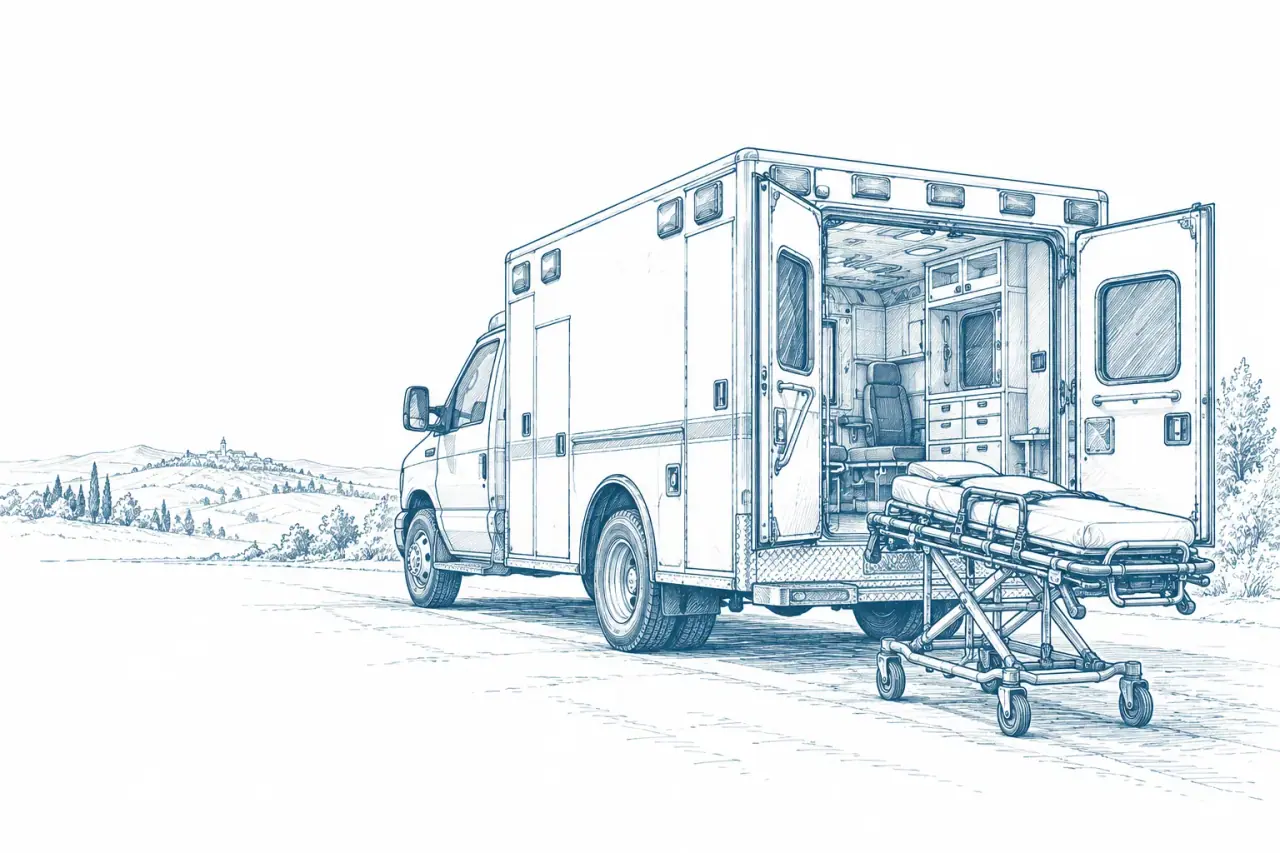
AI medical interpreter for EMS
Opalite gives crews real-time, two-way interpretation in 150+ languages and dialects on a phone or tablet, at the scene or in the rig.
Today's challenge
What gets in the way of interpretation on EMS calls today
Hold music at the scene
Stuck in an interpreter phone queue, the paramedic can't ask the family about the patient's last-known-well time.
Kids interpreting in the living room
A child or neighbor in the living room relays the allergy and blood thinner questions and the heart attack risk of staying home.
Nothing to book before a call
No one books an in-person interpreter for a cardiac arrest, a patient waking from naloxone or an unplanned community paramedicine stop.
Cost of inaction
Language interpretation remains a gap in EMS
64.3%
of cardiac arrests with limited-English 9-1-1 callers got bystander CPR in a U.S. study, versus 77.5% of other cases, with dispatchers recognizing arrest later (median 84 vs 50 seconds).
Source: Bystander CPR in out-of-hospital cardiac arrest: the role of limited English proficiency
Meet Opalite.
Real-time AI medical interpretation in 150+ languages and dialects, connecting providers and patients in seconds.
- Works on the devices care teams already carry: phones, tablets, computers, and telehealth platforms
- Integrates with all EHRs
- Built for HIPAA-compliant healthcare
- SOC 2 Type II attested security controls
Workflow
How Opalite fits the call
| Stage | What happens | How Opalite supports it |
|---|---|---|
| Scene arrival | Size-up, chief complaint, patient identification | Spoken interpretation on the crew's phone or tablet, with no scheduling or hold queue |
| Transport decision | Destination, refusal discussion, release | Interpretation of risks and alternatives, with every encounter logged and reviewable. |
| Community paramedicine | Home visits, follow-up calls | In-person interpretation on a tablet, plus phone interpretation on any line, including landlines |
Clinical use cases
Interpret the conversations that matter most
Onset and last known well
EnglishWhen did you last see him normal, before his face drooped and his speech changed?
Spanish¿Cuándo fue la última vez que lo vio normal, antes de que se le cayera la cara y le cambiara el habla?
SAMPLE history
EnglishAny allergies? Do you take blood thinners or insulin, or have you had surgery recently?
Chinese (Mandarin)您对什么过敏吗?在吃抗凝血的药或者打胰岛素吗?最近做过手术吗?
Refusal of care
EnglishIf you stay home, you could have a heart attack. Call 911 again if the pain returns.
Arabicإذا بقيت في المنزل، فقد تُصاب بنوبة قلبية. اتصل بالرقم 911 مرة أخرى إذا عاد الألم.
After naloxone
EnglishYou stopped breathing from an overdose. The medicine can wear off, so please come to the hospital.
SpanishDejó de respirar por una sobredosis. La medicina que le pusimos puede dejar de hacer efecto, así que por favor venga al hospital.
Community paramedicine visits
EnglishShow me the medicines you are taking now. Call 911 if you get short of breath.
Chinese (Mandarin)请把您现在在吃的药给我看看。如果喘不上气,就打911。
Success metrics
How you'll know it's working
Time to interpreter. Seconds from the interpret decision to the first interpreted word, measured from scene arrival on each call.
Documented informed refusals. The share of language-barrier refusals with an interpreted risk discussion.
Ad hoc interpretation. Calls with bystanders or children interpreting, a count expected to fall.
Pricing
Pricing for EMS agencies
Long refusals cost the same. A flat rate scoped to your stations, units or usage gives crews no billing reason to rush a refusal discussion.
In your area
25.5 million people in the U.S. speak English less than “very well.”
How many live near you? Search your state, ZIP code, or town.
Darker states have a higher share of residents who speak English less than very well; shading is logarithmic, relative to the highest-share state.
| State | Share | People |
|---|---|---|
| California | 17.2% | 6,377,000 |
| Texas | 13.1% | 3,532,000 |
| New York | 13.1% | 2,486,000 |
| New Jersey | 12.2% | 1,060,000 |
| Florida | 11.8% | 2,389,000 |
| Hawaii | 11.2% | 152,900 |
| Nevada | 11.1% | 320,200 |
| Massachusetts | 9.5% | 631,900 |
| New Mexico | 8.7% | 172,700 |
| Illinois | 8.5% | 1,027,000 |
| Connecticut | 8.4% | 288,200 |
| Rhode Island | 8.4% | 87,250 |
| Arizona | 8.1% | 542,400 |
| Washington | 7.6% | 547,600 |
| Maryland | 7.1% | 411,700 |
| Virginia | 5.8% | 469,000 |
| Colorado | 5.5% | 295,600 |
| Georgia | 5.4% | 541,600 |
| District of Columbia | 5.4% | 34,600 |
| Oregon | 5.4% | 214,100 |
| Nebraska | 5.1% | 93,560 |
| Delaware | 4.9% | 45,460 |
| Utah | 4.7% | 140,000 |
| Kansas | 4.5% | 124,100 |
| Minnesota | 4.5% | 239,600 |
| North Carolina | 4.5% | 439,200 |
| Pennsylvania | 4.4% | 544,000 |
| Alaska | 4.3% | 29,650 |
| Oklahoma | 3.8% | 142,200 |
| Idaho | 3.7% | 62,850 |
| Iowa | 3.4% | 100,800 |
| Michigan | 3.4% | 318,900 |
| Arkansas | 3.2% | 90,380 |
| Indiana | 3.2% | 200,900 |
| Tennessee | 3.1% | 197,500 |
| Wisconsin | 3.0% | 164,200 |
| Louisiana | 2.8% | 123,500 |
| South Carolina | 2.8% | 132,700 |
| Ohio | 2.5% | 281,500 |
| Kentucky | 2.4% | 101,800 |
| New Hampshire | 2.4% | 31,410 |
| Missouri | 2.1% | 123,000 |
| Alabama | 2.1% | 98,720 |
| South Dakota | 1.9% | 15,800 |
| North Dakota | 1.9% | 13,810 |
| Wyoming | 1.8% | 9,923 |
| Mississippi | 1.6% | 44,870 |
| Maine | 1.4% | 18,140 |
| Vermont | 1.3% | 7,705 |
| Montana | 0.8% | 7,731 |
| West Virginia | 0.6% | 11,060 |
Source: U.S. Census Bureau ACS (states 2017-2021; metros 2024 or 2020-2024). Limited English: residents 5+ who speak English less than “very well.”
FAQ
Frequently asked questions
Explore