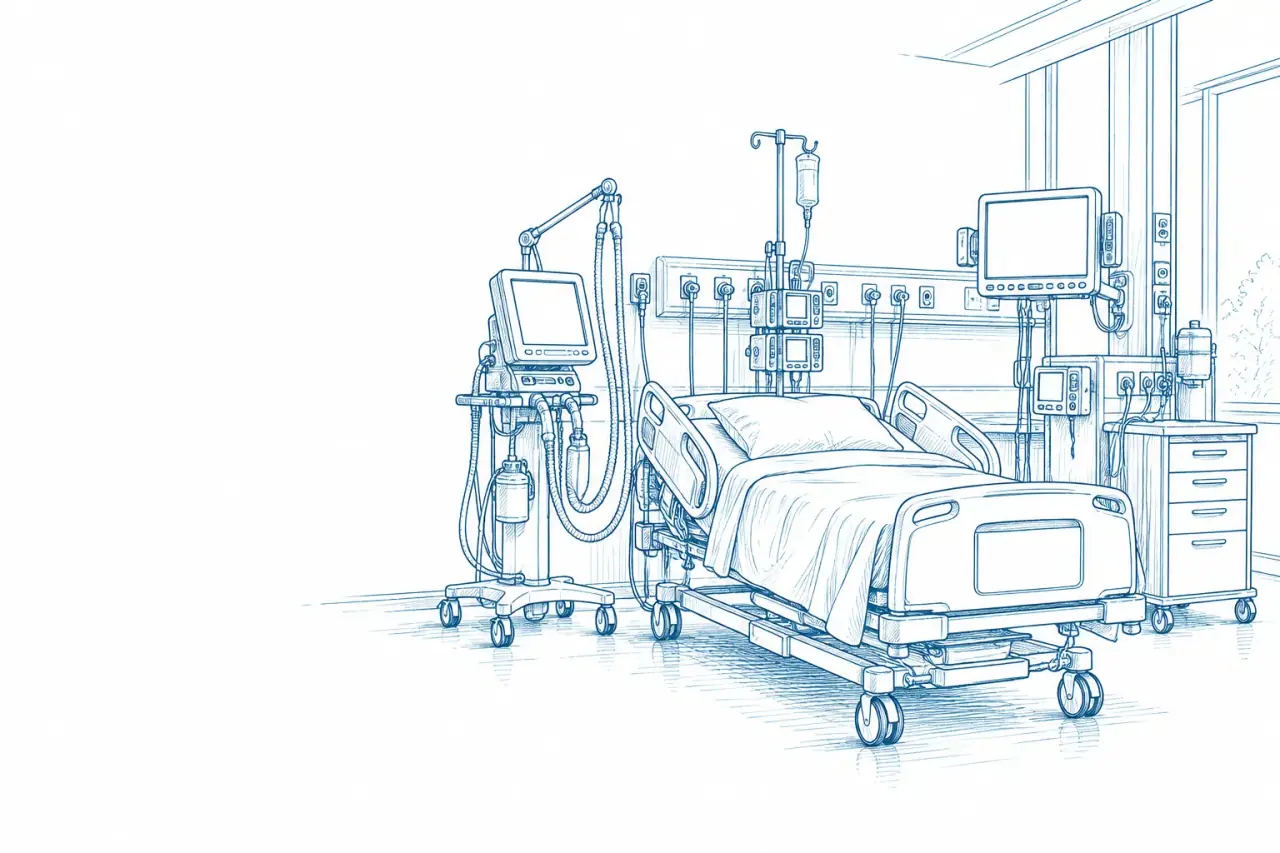
AI medical interpreter for critical care
Opalite gives ICU teams real-time interpretation in 150+ languages and dialects, 24/7, for night calls, family updates and bedside assessments.
Today's challenge
What gets in the way of interpretation in the ICU today
A nurse pulled to interpret
A bilingual ICU nurse leaves her own two patients to interpret a neighbor's pain check.
Sudden declines skip the booking
A sudden afternoon decline falls outside the interpreter's reserved morning hour.
A Dari- or Sylheti-speaking surrogate
With a Dari or Sylheti surrogate, the code status conversation waits for the interpreter line to find a match.
Cost of inaction
Language interpretation remains a gap in critical care
3.8 days longer
Patients with LEP in 7 ICUs at one academic center waited longer for a DNR order and changed from full code less often.
Meet Opalite.
Real-time AI medical interpretation in 150+ languages and dialects, connecting providers and patients in seconds.
- Works on the devices care teams already carry: phones, tablets, computers, and telehealth platforms
- Integrates with all EHRs
- Built for HIPAA-compliant healthcare
- SOC 2 Type II attested security controls
Workflow
How Opalite fits the ICU day
| Stage | What happens | How Opalite supports it |
|---|---|---|
| Admission and night calls | History, allergies, emergency consent, first family call | Phone interpretation on any line, including landlines, 24/7 |
| Bedside assessment | Delirium screens, pain checks, neurologic questions | Real-time two-way interpretation on a bedside tablet or computer |
| Rounds and daily updates | Plan of the day, test results, family questions | No scheduling or wait, with Guardian on every sentence |
Clinical use cases
Interpret the conversations that matter most
Emergency consent
EnglishYour husband needs a breathing tube now. Do we have your permission to place it?
SpanishSu esposo necesita un tubo para respirar ahora mismo. ¿Nos da su permiso para colocárselo?
Home medications and allergies
EnglishIs he allergic to any medicine, like penicillin? What pills does he take at home?
Chinese (Mandarin)他对什么药过敏吗,比如青霉素?他在家吃哪些药?
Naming the spokesperson
EnglishWho should we talk to when he cannot make decisions for himself?
Arabicمع من يجب أن نتحدث عندما لا يستطيع اتخاذ القرارات بنفسه؟
Daily family updates
EnglishHis oxygen improved overnight. Today we will turn down the breathing machine and repeat his chest X-ray.
SpanishSu oxígeno mejoró durante la noche. Hoy vamos a bajar el apoyo del respirador y repetir la radiografía de tórax.
Teach-back with families
EnglishCan you tell me in your own words what we are doing for him today?
Chinese (Mandarin)您能用自己的话告诉我,我们今天要为他做什么吗?
Success metrics
How you'll know it's working
Daily updates in the family's language. Share of ICU days with a documented interpreted family update.
Night time to interpreter. Seconds from a night resident's decision to interpret to the start of interpretation, 7 p.m. to 7 a.m., including calls to family.
Pricing
Pricing for critical care units
Family meetings without a clock. Goals-of-care meetings and overnight consent calls of any length carry no per-minute meter at a flat rate for your ICUs or departments.
In your area
25.5 million people in the U.S. speak English less than “very well.”
How many live near you? Search your state, ZIP code, or town.
Darker states have a higher share of residents who speak English less than very well; shading is logarithmic, relative to the highest-share state.
| State | Share | People |
|---|---|---|
| California | 17.2% | 6,377,000 |
| Texas | 13.1% | 3,532,000 |
| New York | 13.1% | 2,486,000 |
| New Jersey | 12.2% | 1,060,000 |
| Florida | 11.8% | 2,389,000 |
| Hawaii | 11.2% | 152,900 |
| Nevada | 11.1% | 320,200 |
| Massachusetts | 9.5% | 631,900 |
| New Mexico | 8.7% | 172,700 |
| Illinois | 8.5% | 1,027,000 |
| Connecticut | 8.4% | 288,200 |
| Rhode Island | 8.4% | 87,250 |
| Arizona | 8.1% | 542,400 |
| Washington | 7.6% | 547,600 |
| Maryland | 7.1% | 411,700 |
| Virginia | 5.8% | 469,000 |
| Colorado | 5.5% | 295,600 |
| Georgia | 5.4% | 541,600 |
| District of Columbia | 5.4% | 34,600 |
| Oregon | 5.4% | 214,100 |
| Nebraska | 5.1% | 93,560 |
| Delaware | 4.9% | 45,460 |
| Utah | 4.7% | 140,000 |
| Kansas | 4.5% | 124,100 |
| Minnesota | 4.5% | 239,600 |
| North Carolina | 4.5% | 439,200 |
| Pennsylvania | 4.4% | 544,000 |
| Alaska | 4.3% | 29,650 |
| Oklahoma | 3.8% | 142,200 |
| Idaho | 3.7% | 62,850 |
| Iowa | 3.4% | 100,800 |
| Michigan | 3.4% | 318,900 |
| Arkansas | 3.2% | 90,380 |
| Indiana | 3.2% | 200,900 |
| Tennessee | 3.1% | 197,500 |
| Wisconsin | 3.0% | 164,200 |
| Louisiana | 2.8% | 123,500 |
| South Carolina | 2.8% | 132,700 |
| Ohio | 2.5% | 281,500 |
| Kentucky | 2.4% | 101,800 |
| New Hampshire | 2.4% | 31,410 |
| Missouri | 2.1% | 123,000 |
| Alabama | 2.1% | 98,720 |
| South Dakota | 1.9% | 15,800 |
| North Dakota | 1.9% | 13,810 |
| Wyoming | 1.8% | 9,923 |
| Mississippi | 1.6% | 44,870 |
| Maine | 1.4% | 18,140 |
| Vermont | 1.3% | 7,705 |
| Montana | 0.8% | 7,731 |
| West Virginia | 0.6% | 11,060 |
Source: U.S. Census Bureau ACS (states 2017-2021; metros 2024 or 2020-2024). Limited English: residents 5+ who speak English less than “very well.”
FAQ
Frequently asked questions
See Opalite in critical care.
See an interpreted night call and family update in your families' languages.