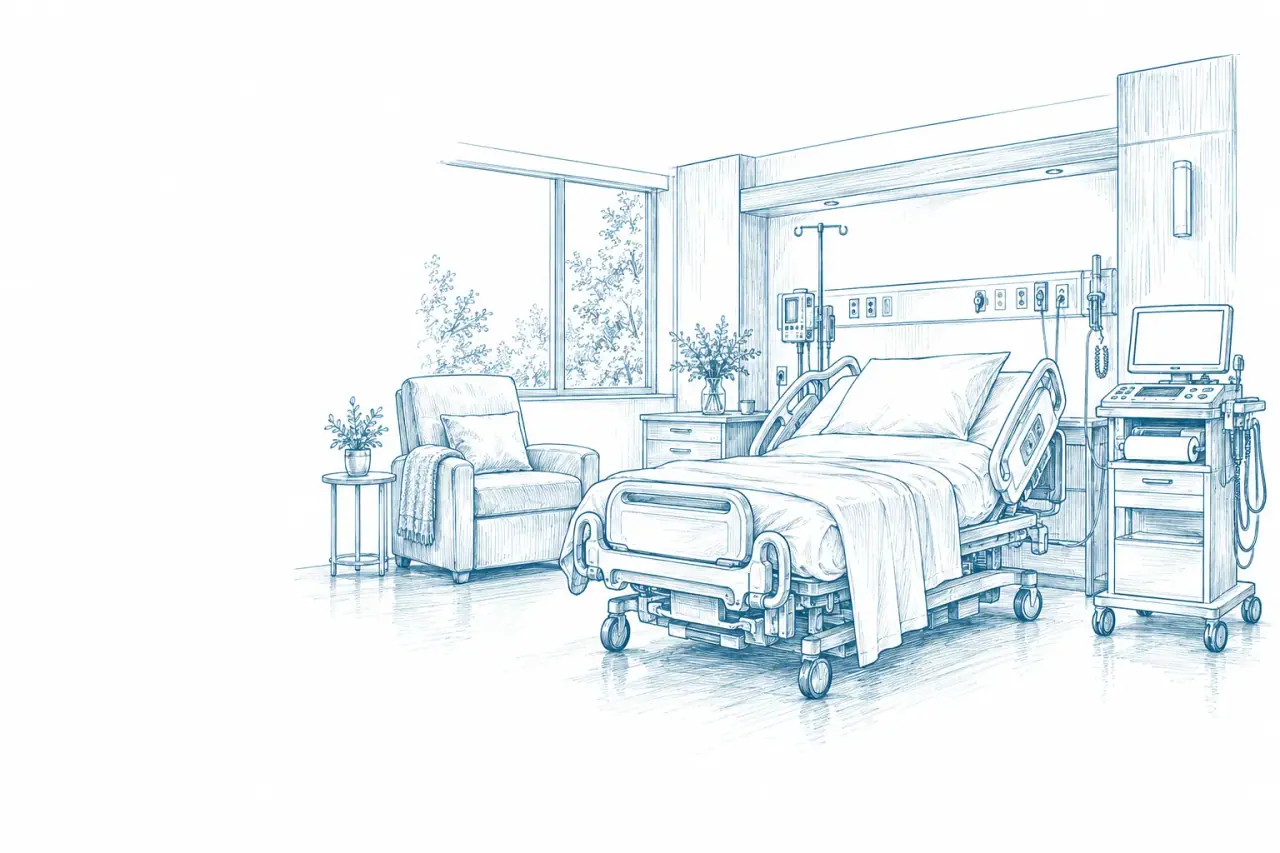
AI medical interpreter for labor and delivery and maternal-fetal medicine
Opalite gives labor and delivery and maternal-fetal medicine teams real-time interpretation in 150+ languages and dialects, 24/7, from triage and consent to hemorrhage response and high-risk pregnancy visits.
Today's challenge
What gets in the way of interpretation in labor and delivery today
A husband interprets the safety screen
Her husband interprets the triage nurse's question about violence at home.
Contractions during the hold
A laboring patient rides out contractions in triage with the nurse on hold for a phone interpreter.
French for a Haitian Creole speaker
A Haitian Creole speaker in early labor gets a French phone interpreter for her epidural questions.
Cost of inaction
Language interpretation remains a gap in labor and delivery and maternal-fetal medicine
22.9%
of non-English speakers with postpartum hemorrhage at one New York City hospital received a transfusion, versus 28.2% of English speakers with similar blood loss.
Source: Language-Based Inequities in Transfusion Practices with Obstetric Hemorrhage
Meet Opalite.
Real-time AI medical interpretation in 150+ languages and dialects, connecting providers and patients in seconds.
- Works on the devices care teams already carry: phones, tablets, computers, and telehealth platforms
- Integrates with all EHRs
- Built for HIPAA-compliant healthcare
- SOC 2 Type II attested security controls
Workflow
How Opalite fits labor, delivery and high-risk pregnancy care
| Stage | What happens | How Opalite supports it |
|---|---|---|
| Triage and admission | Labor checks, bleeding and fluid questions, pregnancy history | Interpretation on a tablet or phone, 24/7, with no scheduling |
| Labor, delivery and emergencies | Epidural, induction, cesarean and transfusion consent | Two-way interpretation at the bedside, with Guardian checking every sentence |
| MFM visits and postpartum | Ultrasound results, preeclampsia teaching, lactation and warning signs | Video for telehealth MFM visits, phone for postpartum calls, and notes to the EHR after clinician review |
Clinical use cases
Interpret the conversations that matter most
Emergency cesarean consent
EnglishWe need to deliver your baby by cesarean now because the heart rate is dropping. Do you agree?
SpanishTenemos que sacar a su bebé por cesárea ahora porque el ritmo cardíaco está bajando. ¿Está de acuerdo?
Postpartum hemorrhage
EnglishYou are bleeding heavily, and we recommend a blood transfusion. Do you agree to receive blood?
Chinese (Mandarin)您出血很多,我们建议给您输血。您同意输血吗?
Magnesium for preeclampsia
EnglishThis medicine helps prevent seizures. Tell us right away if you have trouble breathing.
Arabicهذا الدواء يساعد على منع التشنجات. أخبرينا فورًا إذا شعرتِ بصعوبة في التنفس.
Kick counts at home
EnglishCount your baby's kicks every evening. Call us if you feel fewer than 10 in two hours.
SpanishCuente las patadas de su bebé todas las tardes. Llámenos si siente menos de 10 en dos horas.
Fetal anomaly results
EnglishThe ultrasound shows a problem with the baby's heart. A specialist will explain your options today.
Chinese (Mandarin)超声检查显示宝宝的心脏有问题。专科医生今天会向您说明有哪些选择。
Pricing
Pricing for labor and delivery units
Triage to postpartum, one rate. Pricing is a flat rate scoped to your labor unit, MFM clinics or overall usage, with no per-minute meter on long inductions or overnight deliveries.
In your area
25.5 million people in the U.S. speak English less than “very well.”
How many live near you? Search your state, ZIP code, or town.
Darker states have a higher share of residents who speak English less than very well; shading is logarithmic, relative to the highest-share state.
| State | Share | People |
|---|---|---|
| California | 17.2% | 6,377,000 |
| Texas | 13.1% | 3,532,000 |
| New York | 13.1% | 2,486,000 |
| New Jersey | 12.2% | 1,060,000 |
| Florida | 11.8% | 2,389,000 |
| Hawaii | 11.2% | 152,900 |
| Nevada | 11.1% | 320,200 |
| Massachusetts | 9.5% | 631,900 |
| New Mexico | 8.7% | 172,700 |
| Illinois | 8.5% | 1,027,000 |
| Connecticut | 8.4% | 288,200 |
| Rhode Island | 8.4% | 87,250 |
| Arizona | 8.1% | 542,400 |
| Washington | 7.6% | 547,600 |
| Maryland | 7.1% | 411,700 |
| Virginia | 5.8% | 469,000 |
| Colorado | 5.5% | 295,600 |
| Georgia | 5.4% | 541,600 |
| District of Columbia | 5.4% | 34,600 |
| Oregon | 5.4% | 214,100 |
| Nebraska | 5.1% | 93,560 |
| Delaware | 4.9% | 45,460 |
| Utah | 4.7% | 140,000 |
| Kansas | 4.5% | 124,100 |
| Minnesota | 4.5% | 239,600 |
| North Carolina | 4.5% | 439,200 |
| Pennsylvania | 4.4% | 544,000 |
| Alaska | 4.3% | 29,650 |
| Oklahoma | 3.8% | 142,200 |
| Idaho | 3.7% | 62,850 |
| Iowa | 3.4% | 100,800 |
| Michigan | 3.4% | 318,900 |
| Arkansas | 3.2% | 90,380 |
| Indiana | 3.2% | 200,900 |
| Tennessee | 3.1% | 197,500 |
| Wisconsin | 3.0% | 164,200 |
| Louisiana | 2.8% | 123,500 |
| South Carolina | 2.8% | 132,700 |
| Ohio | 2.5% | 281,500 |
| Kentucky | 2.4% | 101,800 |
| New Hampshire | 2.4% | 31,410 |
| Missouri | 2.1% | 123,000 |
| Alabama | 2.1% | 98,720 |
| South Dakota | 1.9% | 15,800 |
| North Dakota | 1.9% | 13,810 |
| Wyoming | 1.8% | 9,923 |
| Mississippi | 1.6% | 44,870 |
| Maine | 1.4% | 18,140 |
| Vermont | 1.3% | 7,705 |
| Montana | 0.8% | 7,731 |
| West Virginia | 0.6% | 11,060 |
Source: U.S. Census Bureau ACS (states 2017-2021; metros 2024 or 2020-2024). Limited English: residents 5+ who speak English less than “very well.”
FAQ
Frequently asked questions
Explore
Where labor and delivery and maternal-fetal medicine is practiced
Related
See Opalite in labor and delivery and maternal-fetal medicine.
Run a triage, consent or ultrasound results conversation in your patients' languages.