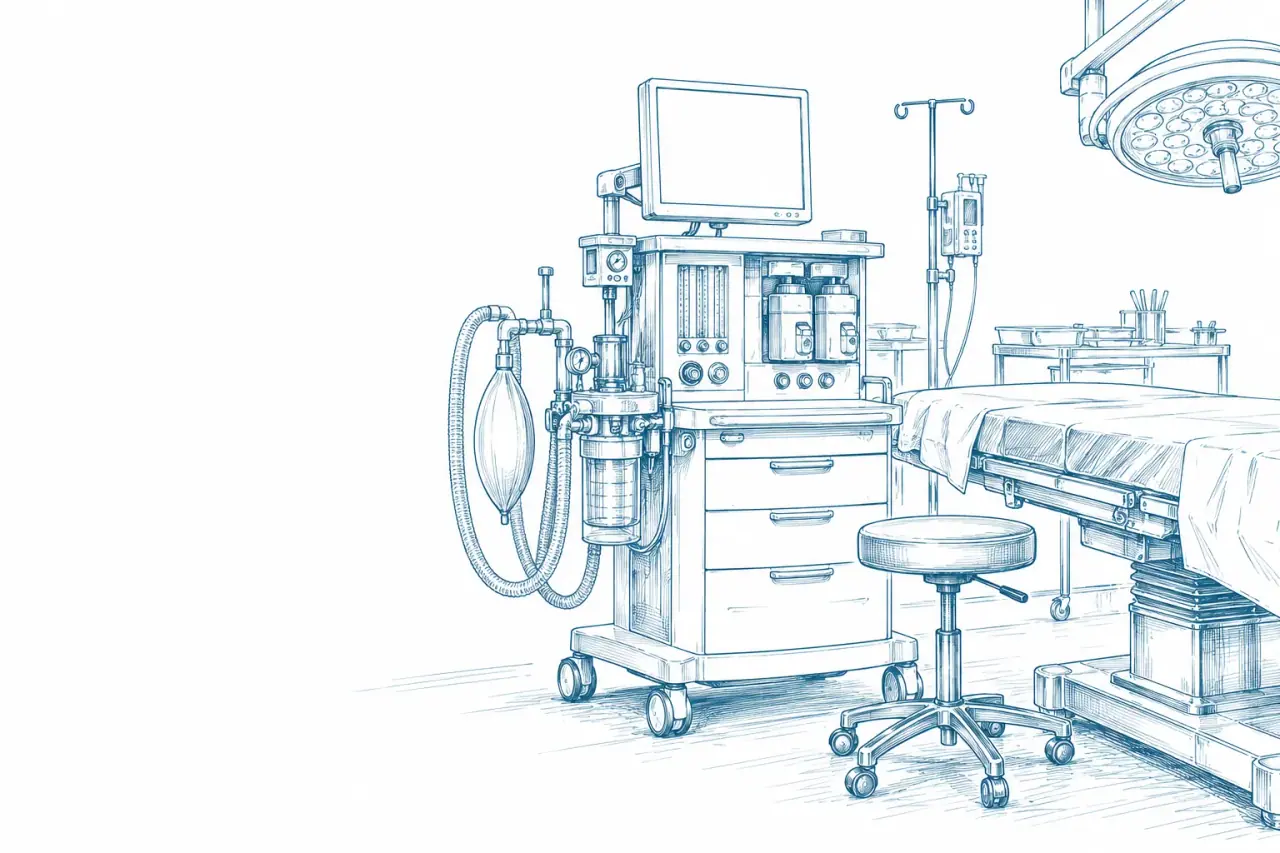
AI medical interpreter for anesthesiology
Opalite gives anesthesia teams real-time interpretation in 150+ languages and dialects, 24/7, from the preoperative interview to labor epidurals and PACU pain checks.
Today's challenge
What gets in the way of interpretation in anesthesiology today
On hold in pre-op holding
Meeting the patient minutes before the first case, the anesthesiologist holds for a phone interpreter with the OR schedule slipping.
A circulating nurse interpreting
A bilingual circulating nurse leaves her own room to relay the allergy and loose-teeth questions.
No match for an evening add-on
An evening add-on case leaves a Haitian Creole speaker in pre-op without a matched interpreter.
Cost of inaction
Language interpretation remains a gap in anesthesiology
3x the odds
of no recorded pain score applied to limited-English children over 5 after appendectomy in one San Francisco PACU.
34.9%
of Spanish-speaking Latino families at Children's Hospital Los Angeles accepted a caudal block before urologic surgery.
Meet Opalite.
Real-time AI medical interpretation in 150+ languages and dialects, connecting providers and patients in seconds.
- Works on the devices care teams already carry: phones, tablets, computers, and telehealth platforms
- Integrates with all EHRs
- Built for HIPAA-compliant healthcare
- SOC 2 Type II attested security controls
Workflow
How Opalite fits the perioperative day
| Stage | What happens | How Opalite supports it |
|---|---|---|
| Preoperative evaluation | Health history, airway questions, fasting and medication instructions | Phone interpretation on any line, or video for telehealth evaluations |
| Holding bay and consent | Anesthetic plan, nerve block or epidural consent, final checks | Interpretation on a bay tablet with no scheduling or wait |
| PACU and discharge | Pain and nausea checks, block care, ride-home instructions | Two-way interpretation at the bedside, with documentation going to the EHR after clinician review |
Clinical use cases
Interpret the conversations that matter most
Fasting instructions
EnglishDo not eat anything after midnight, and stop drinking water two hours before you arrive.
SpanishNo coma nada después de la medianoche, y deje de tomar agua dos horas antes de llegar.
Family history of anesthesia reactions
EnglishHave you or anyone in your family ever had a bad reaction to anesthesia?
Chinese (Mandarin)您或您的家人以前对麻醉有没有过不良反应?
After a nerve block
EnglishYour leg will stay numb for many hours, so do not stand up without a nurse.
Arabicستبقى ساقك مخدّرة لساعات طويلة، لذا لا تقف دون وجود ممرضة.
Placing a labor epidural
EnglishCurl your back and hold very still, even during a contraction, while I place the epidural.
SpanishEncorve la espalda y quédese muy quieta, incluso durante una contracción, mientras le pongo la epidural.
Pain scores in recovery
EnglishPoint to the number from 0 to 10 that shows how much pain you have right now.
Chinese (Mandarin)请指出从0到10中哪个数字代表您现在有多痛。
Pricing
Pricing for anesthesia departments
Pre-op call to PACU, one rate. Pricing is a flat rate scoped to your anesthesia department or surgical sites, with no per-minute meter on preoperative calls, consent talks or slow wake-ups.
In your area
25.5 million people in the U.S. speak English less than “very well.”
How many live near you? Search your state, ZIP code, or town.
Darker states have a higher share of residents who speak English less than very well; shading is logarithmic, relative to the highest-share state.
| State | Share | People |
|---|---|---|
| California | 17.2% | 6,377,000 |
| Texas | 13.1% | 3,532,000 |
| New York | 13.1% | 2,486,000 |
| New Jersey | 12.2% | 1,060,000 |
| Florida | 11.8% | 2,389,000 |
| Hawaii | 11.2% | 152,900 |
| Nevada | 11.1% | 320,200 |
| Massachusetts | 9.5% | 631,900 |
| New Mexico | 8.7% | 172,700 |
| Illinois | 8.5% | 1,027,000 |
| Connecticut | 8.4% | 288,200 |
| Rhode Island | 8.4% | 87,250 |
| Arizona | 8.1% | 542,400 |
| Washington | 7.6% | 547,600 |
| Maryland | 7.1% | 411,700 |
| Virginia | 5.8% | 469,000 |
| Colorado | 5.5% | 295,600 |
| Georgia | 5.4% | 541,600 |
| District of Columbia | 5.4% | 34,600 |
| Oregon | 5.4% | 214,100 |
| Nebraska | 5.1% | 93,560 |
| Delaware | 4.9% | 45,460 |
| Utah | 4.7% | 140,000 |
| Kansas | 4.5% | 124,100 |
| Minnesota | 4.5% | 239,600 |
| North Carolina | 4.5% | 439,200 |
| Pennsylvania | 4.4% | 544,000 |
| Alaska | 4.3% | 29,650 |
| Oklahoma | 3.8% | 142,200 |
| Idaho | 3.7% | 62,850 |
| Iowa | 3.4% | 100,800 |
| Michigan | 3.4% | 318,900 |
| Arkansas | 3.2% | 90,380 |
| Indiana | 3.2% | 200,900 |
| Tennessee | 3.1% | 197,500 |
| Wisconsin | 3.0% | 164,200 |
| Louisiana | 2.8% | 123,500 |
| South Carolina | 2.8% | 132,700 |
| Ohio | 2.5% | 281,500 |
| Kentucky | 2.4% | 101,800 |
| New Hampshire | 2.4% | 31,410 |
| Missouri | 2.1% | 123,000 |
| Alabama | 2.1% | 98,720 |
| South Dakota | 1.9% | 15,800 |
| North Dakota | 1.9% | 13,810 |
| Wyoming | 1.8% | 9,923 |
| Mississippi | 1.6% | 44,870 |
| Maine | 1.4% | 18,140 |
| Vermont | 1.3% | 7,705 |
| Montana | 0.8% | 7,731 |
| West Virginia | 0.6% | 11,060 |
Source: U.S. Census Bureau ACS (states 2017-2021; metros 2024 or 2020-2024). Limited English: residents 5+ who speak English less than “very well.”
FAQ
Frequently asked questions
Explore
Where anesthesiology is practiced
Related
See Opalite in anesthesiology.
Run a preoperative interview or a PACU pain check in your patients' languages.