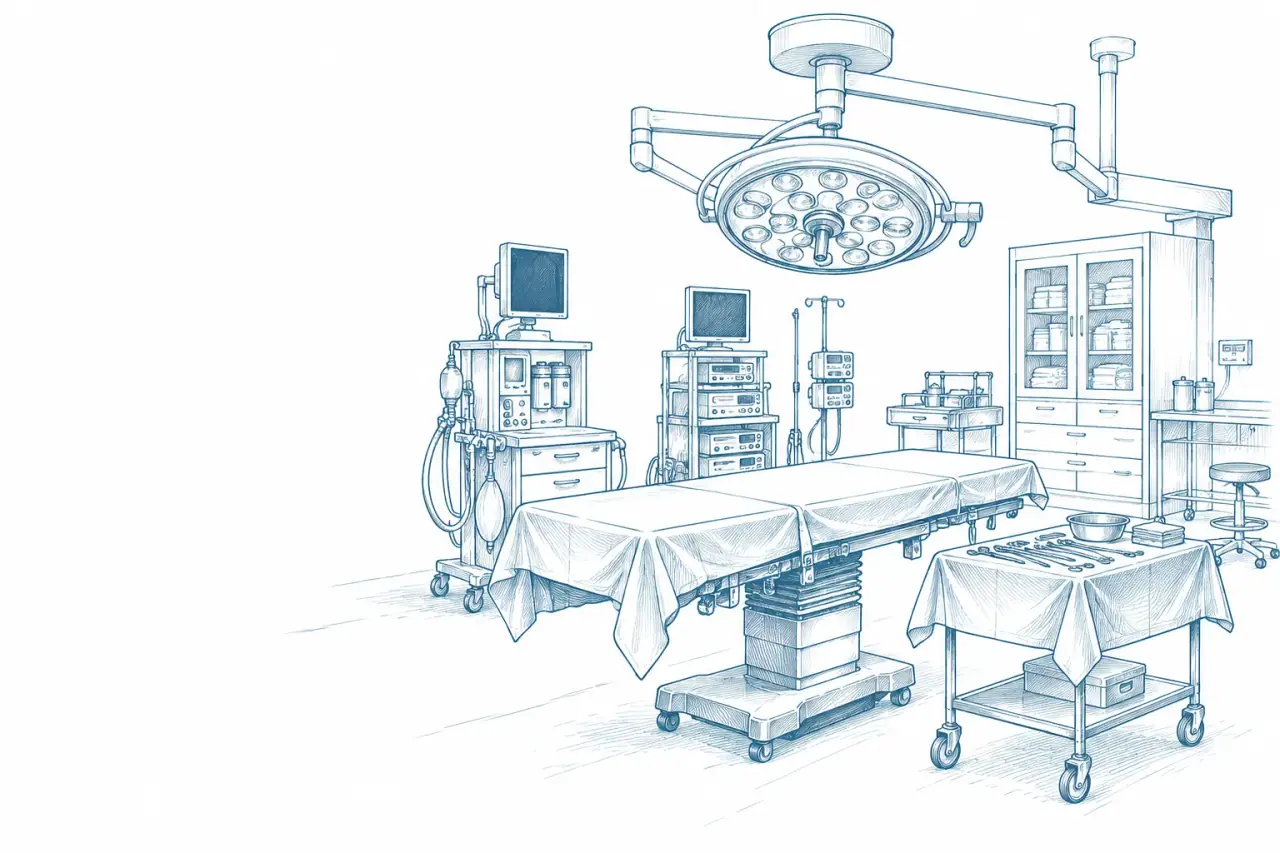
AI medical interpreter for general surgery
Opalite interprets every consult, preadmission call and discharge talk in 150+ languages and dialects, 24/7.
Today's challenge
What gets in the way of interpretation in general surgery today
The PACU wake-up nobody booked for
Pre-op holding questions and PACU wake-ups follow the OR schedule, not an in-person interpreter's booked hour.
A teenager relays the lifting limits
A teenage son relays his mother's post-hernia lifting limits in his own loose words.
The gallbladder consult on hold
An on-call surgeon waits in a phone interpreter queue at the bedside of a patient with gallbladder pain.
Cost of inaction
Language interpretation remains a gap in general surgery
2.7x the risk
Patients with a non-English primary language more often returned to the ED after colorectal surgery, with 3.6x the risk for preventable visits.
Source: Preventable Emergency Department Visits After Colorectal Surgery
Meet Opalite.
Real-time AI medical interpretation in 150+ languages and dialects, connecting providers and patients in seconds.
- Works on the devices care teams already carry: phones, tablets, computers, and telehealth platforms
- Integrates with all EHRs
- Built for HIPAA-compliant healthcare
- SOC 2 Type II attested security controls
Workflow
How Opalite fits before, during and after surgery
Preadmission call
Fasting, medication holds, arrival time, ride home
Phone interpretation on any line, including landlines
Pre-op holding
Identity, site and allergy checks, last questions
Available 24/7 with no wait, including for first cases of the day
PACU
Pain, nausea and orientation checks
The same device at the bedside, with no scheduling
Clinical use cases
Interpret the conversations that matter most
The fasting instruction
EnglishNo food after midnight. Clear liquids only until 5 a.m., then nothing by mouth.
SpanishNo coma nada después de la medianoche. Puede tomar solo líquidos claros hasta las 5 de la mañana; después, nada por la boca.
Medication holds before surgery
EnglishStop your warfarin five days before surgery. Do not take your metformin the morning of surgery.
Chinese (Mandarin)手术前五天停用华法林。手术当天早上不要服用二甲双胍。
Informed consent
EnglishWe will start with small incisions, but we may need to switch to one larger incision.
Arabicسنبدأ بشقوق صغيرة، لكن قد نحتاج إلى التحويل إلى شق واحد أكبر.
Pain assessment in PACU
EnglishOn a scale from 0 to 10, how bad is your pain right now?
SpanishEn una escala del 0 al 10, ¿qué tan fuerte es su dolor ahora mismo?
Discharge prescriptions
EnglishThis pill is for pain. Take one every 6 hours only if you need it.
Chinese (Mandarin)这种药是止痛的。需要时才吃,每6小时最多吃一片。
Success metrics
How you'll know it's working
Day-of-surgery delays and cancellations. Count those with language access as a factor.
Time to interpreter. Track seconds to start in pre-op holding and PACU.
Pricing
Pricing for surgical departments
Preadmission to PACU, one rate. A flat rate scoped to your surgical sites or departments covers preadmission calls, consent discussions and slow PACU recoveries with no per-minute meter.
In your area
25.5 million people in the U.S. speak English less than “very well.”
How many live near you? Search your state, ZIP code, or town.
Darker states have a higher share of residents who speak English less than very well; shading is logarithmic, relative to the highest-share state.
| State | Share | People |
|---|---|---|
| California | 17.2% | 6,377,000 |
| Texas | 13.1% | 3,532,000 |
| New York | 13.1% | 2,486,000 |
| New Jersey | 12.2% | 1,060,000 |
| Florida | 11.8% | 2,389,000 |
| Hawaii | 11.2% | 152,900 |
| Nevada | 11.1% | 320,200 |
| Massachusetts | 9.5% | 631,900 |
| New Mexico | 8.7% | 172,700 |
| Illinois | 8.5% | 1,027,000 |
| Connecticut | 8.4% | 288,200 |
| Rhode Island | 8.4% | 87,250 |
| Arizona | 8.1% | 542,400 |
| Washington | 7.6% | 547,600 |
| Maryland | 7.1% | 411,700 |
| Virginia | 5.8% | 469,000 |
| Colorado | 5.5% | 295,600 |
| Georgia | 5.4% | 541,600 |
| District of Columbia | 5.4% | 34,600 |
| Oregon | 5.4% | 214,100 |
| Nebraska | 5.1% | 93,560 |
| Delaware | 4.9% | 45,460 |
| Utah | 4.7% | 140,000 |
| Kansas | 4.5% | 124,100 |
| Minnesota | 4.5% | 239,600 |
| North Carolina | 4.5% | 439,200 |
| Pennsylvania | 4.4% | 544,000 |
| Alaska | 4.3% | 29,650 |
| Oklahoma | 3.8% | 142,200 |
| Idaho | 3.7% | 62,850 |
| Iowa | 3.4% | 100,800 |
| Michigan | 3.4% | 318,900 |
| Arkansas | 3.2% | 90,380 |
| Indiana | 3.2% | 200,900 |
| Tennessee | 3.1% | 197,500 |
| Wisconsin | 3.0% | 164,200 |
| Louisiana | 2.8% | 123,500 |
| South Carolina | 2.8% | 132,700 |
| Ohio | 2.5% | 281,500 |
| Kentucky | 2.4% | 101,800 |
| New Hampshire | 2.4% | 31,410 |
| Missouri | 2.1% | 123,000 |
| Alabama | 2.1% | 98,720 |
| South Dakota | 1.9% | 15,800 |
| North Dakota | 1.9% | 13,810 |
| Wyoming | 1.8% | 9,923 |
| Mississippi | 1.6% | 44,870 |
| Maine | 1.4% | 18,140 |
| Vermont | 1.3% | 7,705 |
| Montana | 0.8% | 7,731 |
| West Virginia | 0.6% | 11,060 |
Source: U.S. Census Bureau ACS (states 2017-2021; metros 2024 or 2020-2024). Limited English: residents 5+ who speak English less than “very well.”
FAQ
Frequently asked questions
Explore
Where general surgery is practiced
Related
See Opalite in general surgery.
Hear a preadmission call and a discharge talk interpreted in your patients' languages.