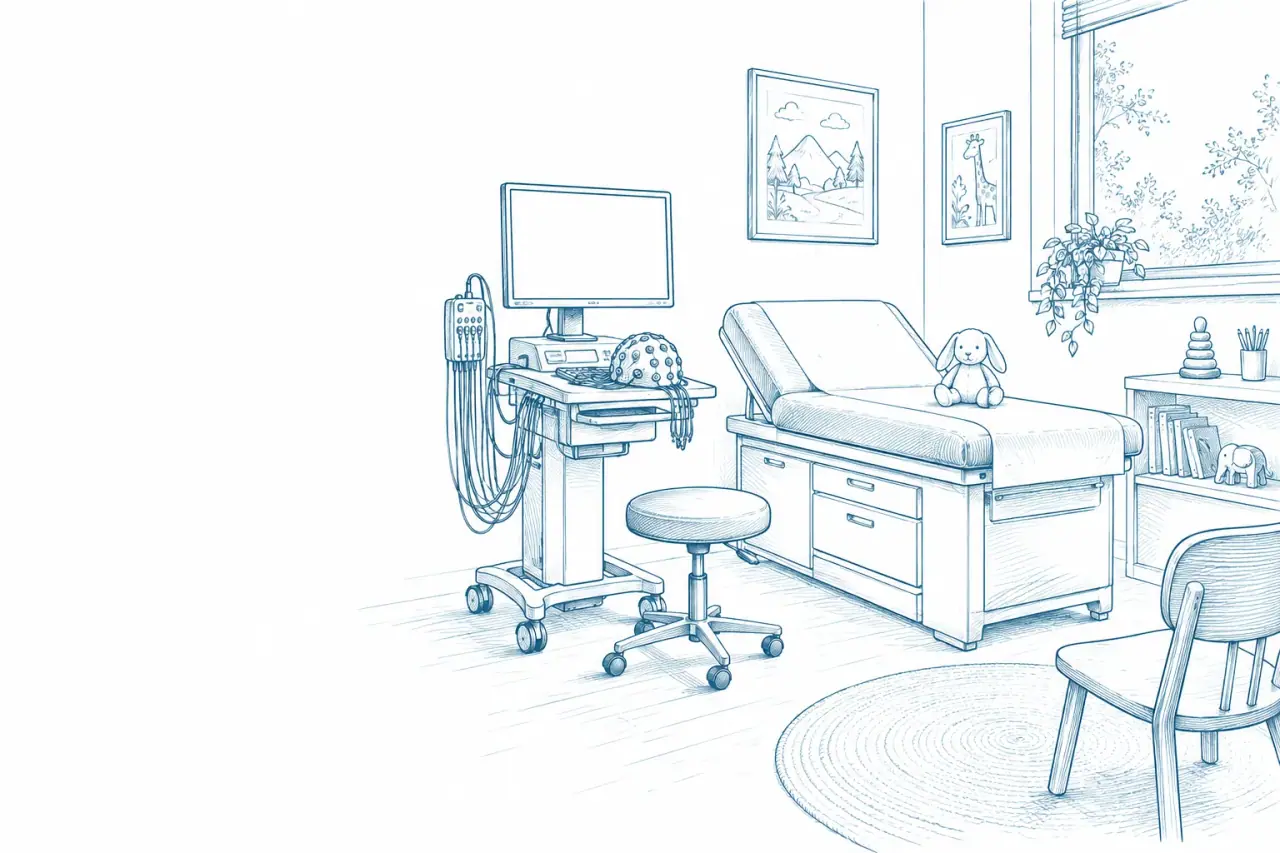
AI medical interpreter for child neurology
Opalite gives child neurology teams real-time spoken interpretation in 150+ languages and dialects, from the EEG lab and epilepsy monitoring unit to rescue-medicine teaching and video follow-up.
Today's challenge
What gets in the way of interpretation in child neurology today
The EEG tech mimes the instructions
The EEG technologist acts out "blow the pinwheel" and "look at the flashing light" for a parent with no interpreter in the room.
A rescue plan heard secondhand
An older sister relays the nasal rescue-spray dose to her mother at the epilepsy monitoring unit discharge.
Pulled back to the clinic for follow-up
A Vietnamese-speaking family drives two hours for a medication check with no interpreter on the video platform.
Cost of inaction
Language interpretation remains a gap in child neurology
22.2% vs. 11.4%
of in-person versus telehealth pediatric neurology visits went to patients preferring another language in California pediatric medical groups during the pandemic.
Source: Use of Telehealth Across Pediatric Subspecialties Before and During the COVID-19 Pandemic
44% vs. 25%
of children with cerebral palsy preferring another language versus English had spinal curves over 90 degrees before surgery at one Minnesota center.
0.56x the odds
of reading a negative COVID-19 test as intended applied to other-language households of children with medical complexity in one Wisconsin survey.
Meet Opalite.
Real-time AI medical interpretation in 150+ languages and dialects, connecting providers and patients in seconds.
- Works on the devices care teams already carry: phones, tablets, computers, and telehealth platforms
- Integrates with all EHRs
- Built for HIPAA-compliant healthcare
- SOC 2 Type II attested security controls
Workflow
How Opalite fits child neurology care
| Stage | What happens | How Opalite supports it |
|---|---|---|
| Clinic and EEG lab | Developmental history, event descriptions, EEG activation steps | Two-way spoken interpretation on the exam-room or EEG-lab tablet, with no booking ahead of the study |
| Epilepsy monitoring unit | Event reports from parents, medication tapers, rescue-plan teaching at discharge | Interpretation at the bedside 24/7, with Guardian checking every sentence of the rescue plan. |
| Follow-up between visits | Medication checks, diet visits, seizure-diary reviews, parent calls | Video visits in Zoom or Microsoft Teams, plus phone interpretation on any line. |
Clinical use cases
Interpret the conversations that matter most
When to give the rescue spray
EnglishIf the seizure lasts longer than 5 minutes, spray one dose in one nostril and call 911.
SpanishSi la convulsión dura más de 5 minutos, rocíe una dosis en una fosa nasal y llame al 911.
Getting ready for a sleep-deprived EEG
EnglishKeep your son awake after midnight before the EEG, and wash his hair with no oil or conditioner.
Chinese (Mandarin)做脑电图前一晚,午夜以后不要让您儿子睡觉,并且给他洗头时不要用发油或护发素。
Filming the next spell
EnglishNext time she has one of these spells, record a video on your phone and bring it to the visit.
Arabicفي المرة القادمة التي تحدث لها فيها هذه النوبة، صوّريها بالفيديو على هاتفك وأحضريه إلى الموعد.
Watching for infantile spasms
EnglishCall us the same day if he has clusters of sudden jerks when he wakes up.
SpanishLlámenos el mismo día si tiene series de sacudidas repentinas cuando se despierta.
Starting the ketogenic diet
EnglishCheck his urine ketones every morning, and do not give juice or sugary medicine syrups.
Chinese (Mandarin)每天早上检查他尿液里的酮体,不要给他喝果汁,也不要给含糖的药物糖浆。
Pricing
Pricing for child neurology services
Long family visits, one rate. A flat rate scoped to your child neurology clinics or monitoring unit keeps hour-long new-diagnosis talks off a per-minute meter.
In your area
25.5 million people in the U.S. speak English less than “very well.”
How many live near you? Search your state, ZIP code, or town.
Darker states have a higher share of residents who speak English less than very well; shading is logarithmic, relative to the highest-share state.
| State | Share | People |
|---|---|---|
| California | 17.2% | 6,377,000 |
| Texas | 13.1% | 3,532,000 |
| New York | 13.1% | 2,486,000 |
| New Jersey | 12.2% | 1,060,000 |
| Florida | 11.8% | 2,389,000 |
| Hawaii | 11.2% | 152,900 |
| Nevada | 11.1% | 320,200 |
| Massachusetts | 9.5% | 631,900 |
| New Mexico | 8.7% | 172,700 |
| Illinois | 8.5% | 1,027,000 |
| Connecticut | 8.4% | 288,200 |
| Rhode Island | 8.4% | 87,250 |
| Arizona | 8.1% | 542,400 |
| Washington | 7.6% | 547,600 |
| Maryland | 7.1% | 411,700 |
| Virginia | 5.8% | 469,000 |
| Colorado | 5.5% | 295,600 |
| Georgia | 5.4% | 541,600 |
| District of Columbia | 5.4% | 34,600 |
| Oregon | 5.4% | 214,100 |
| Nebraska | 5.1% | 93,560 |
| Delaware | 4.9% | 45,460 |
| Utah | 4.7% | 140,000 |
| Kansas | 4.5% | 124,100 |
| Minnesota | 4.5% | 239,600 |
| North Carolina | 4.5% | 439,200 |
| Pennsylvania | 4.4% | 544,000 |
| Alaska | 4.3% | 29,650 |
| Oklahoma | 3.8% | 142,200 |
| Idaho | 3.7% | 62,850 |
| Iowa | 3.4% | 100,800 |
| Michigan | 3.4% | 318,900 |
| Arkansas | 3.2% | 90,380 |
| Indiana | 3.2% | 200,900 |
| Tennessee | 3.1% | 197,500 |
| Wisconsin | 3.0% | 164,200 |
| Louisiana | 2.8% | 123,500 |
| South Carolina | 2.8% | 132,700 |
| Ohio | 2.5% | 281,500 |
| Kentucky | 2.4% | 101,800 |
| New Hampshire | 2.4% | 31,410 |
| Missouri | 2.1% | 123,000 |
| Alabama | 2.1% | 98,720 |
| South Dakota | 1.9% | 15,800 |
| North Dakota | 1.9% | 13,810 |
| Wyoming | 1.8% | 9,923 |
| Mississippi | 1.6% | 44,870 |
| Maine | 1.4% | 18,140 |
| Vermont | 1.3% | 7,705 |
| Montana | 0.8% | 7,731 |
| West Virginia | 0.6% | 11,060 |
Source: U.S. Census Bureau ACS (states 2017-2021; metros 2024 or 2020-2024). Limited English: residents 5+ who speak English less than “very well.”
FAQ
Frequently asked questions
See Opalite in child neurology.
Run an EEG prep call or a seizure rescue-plan teach-back in your families' languages.