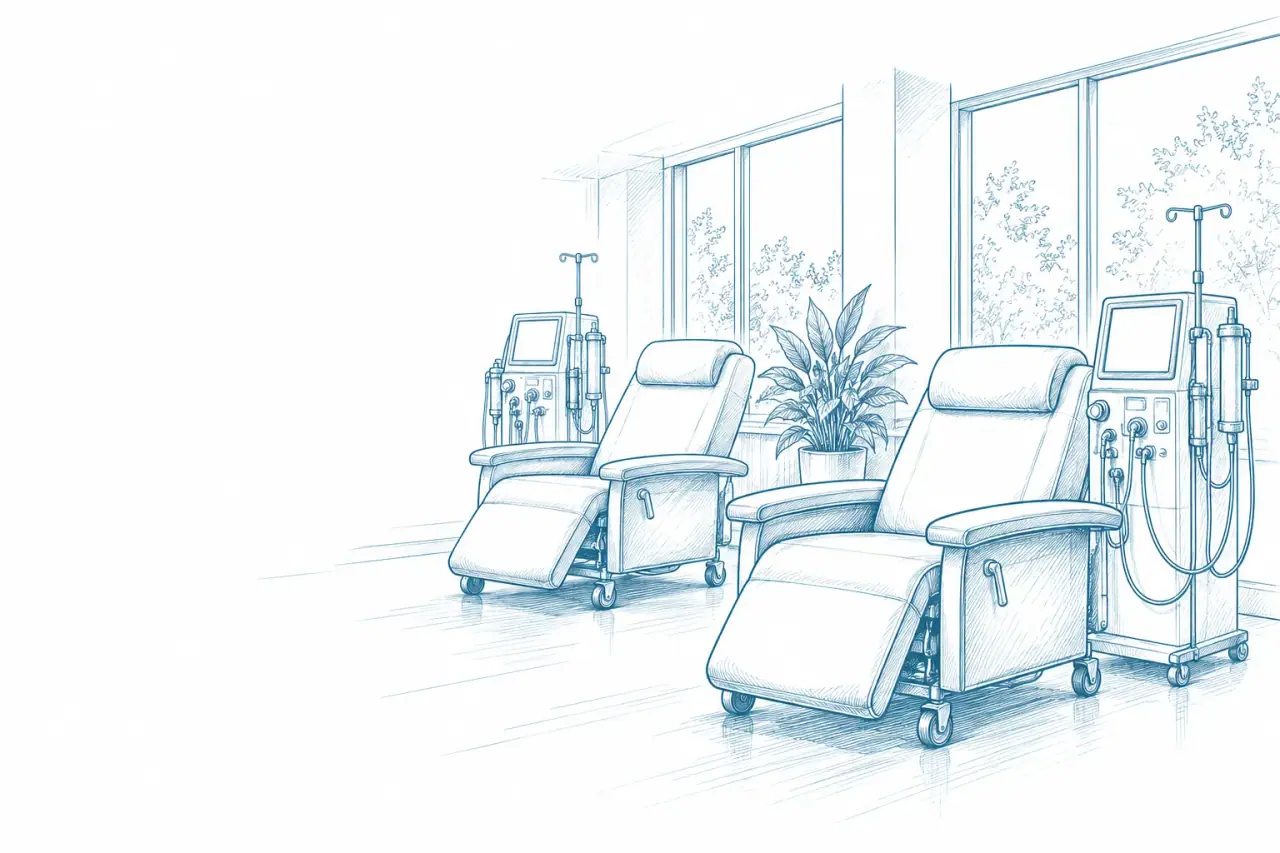
Medical interpretation for dialysis centers
Opalite gives dialysis teams chair-side, real-time interpretation in 150+ languages and dialects at every session, with no wait and no per-minute meter.
Today's challenge
What gets in the way of interpretation in dialysis units today
The meter runs all treatment long
A per-minute interpreter meter makes the nurse weigh the cost of redialing for a mid-treatment cramp or machine alarm.
Technicians pulled in to interpret
A bilingual technician leaves their own chairs to explain a holiday schedule change across the floor.
First shift starts before interpreters
The 5 a.m. first shift puts patients on the machine ahead of any booked interpreter's arrival.
Cost of inaction
Language interpretation remains a gap in dialysis
29% lower rate
Inactive U.S. kidney-transplant candidates in ZIP codes with ≥20% linguistically isolated households reached active waitlist status less often.
Source: Linguistic Isolation and Access to the Active Kidney Transplant Waiting List in the United States
Meet Opalite.
Real-time AI medical interpretation in 150+ languages and dialects, connecting providers and patients in seconds.
- Works on the devices care teams already carry: phones, tablets, computers, and telehealth platforms
- Integrates with all EHRs
- Built for HIPAA-compliant healthcare
- SOC 2 Type II attested security controls
Workflow
How Opalite fits the dialysis schedule
Pre-treatment check
Weight, blood pressure, symptoms since last session
Two-way interpretation with no scheduling, at every chair
During treatment
Access care, symptom checks, alarms, reassurance
The same session runs through the treatment, with Guardian checking every sentence in real time.
Dietitian and social work
Fluid limits, diet, transportation, insurance
One tool for every team member, with no per-language surcharge
Clinical use cases
Interpret the conversations that matter most
The fluid-restriction talk at chair 6
EnglishSoup, tea, ice and watermelon all count as fluid, so keep them within your daily limit.
SpanishLa sopa, el té, el hielo y la sandía cuentan como líquido; manténgalos dentro de su límite diario.
Binders with meals
EnglishTake this phosphate binder with your meal, not before you eat.
Chinese (Mandarin)这种降磷药要和饭一起吃,不要在饭前吃。
Catheter and fistula care
EnglishKeep the dressing dry, and do not let anyone put a blood pressure cuff on this arm.
Arabicحافظ على الضماد جافًا، ولا تسمح لأحد بوضع جهاز قياس الضغط على هذه الذراع.
Symptoms during treatment
SpanishTengo calambres en las piernas, estoy mareado y siento el pecho apretado.
EnglishMy legs are cramping, I feel dizzy, and my chest feels tight.
Pricing
Pricing for dialysis centers
Every chair, every shift, one rate. A flat rate scoped to your units or usage, with no per-minute meter, keeps a long treatment from adding to the interpretation bill.
In your area
25.5 million people in the U.S. speak English less than “very well.”
How many live near you? Search your state, ZIP code, or town.
Darker states have a higher share of residents who speak English less than very well; shading is logarithmic, relative to the highest-share state.
| State | Share | People |
|---|---|---|
| California | 17.2% | 6,377,000 |
| Texas | 13.1% | 3,532,000 |
| New York | 13.1% | 2,486,000 |
| New Jersey | 12.2% | 1,060,000 |
| Florida | 11.8% | 2,389,000 |
| Hawaii | 11.2% | 152,900 |
| Nevada | 11.1% | 320,200 |
| Massachusetts | 9.5% | 631,900 |
| New Mexico | 8.7% | 172,700 |
| Illinois | 8.5% | 1,027,000 |
| Connecticut | 8.4% | 288,200 |
| Rhode Island | 8.4% | 87,250 |
| Arizona | 8.1% | 542,400 |
| Washington | 7.6% | 547,600 |
| Maryland | 7.1% | 411,700 |
| Virginia | 5.8% | 469,000 |
| Colorado | 5.5% | 295,600 |
| Georgia | 5.4% | 541,600 |
| District of Columbia | 5.4% | 34,600 |
| Oregon | 5.4% | 214,100 |
| Nebraska | 5.1% | 93,560 |
| Delaware | 4.9% | 45,460 |
| Utah | 4.7% | 140,000 |
| Kansas | 4.5% | 124,100 |
| Minnesota | 4.5% | 239,600 |
| North Carolina | 4.5% | 439,200 |
| Pennsylvania | 4.4% | 544,000 |
| Alaska | 4.3% | 29,650 |
| Oklahoma | 3.8% | 142,200 |
| Idaho | 3.7% | 62,850 |
| Iowa | 3.4% | 100,800 |
| Michigan | 3.4% | 318,900 |
| Arkansas | 3.2% | 90,380 |
| Indiana | 3.2% | 200,900 |
| Tennessee | 3.1% | 197,500 |
| Wisconsin | 3.0% | 164,200 |
| Louisiana | 2.8% | 123,500 |
| South Carolina | 2.8% | 132,700 |
| Ohio | 2.5% | 281,500 |
| Kentucky | 2.4% | 101,800 |
| New Hampshire | 2.4% | 31,410 |
| Missouri | 2.1% | 123,000 |
| Alabama | 2.1% | 98,720 |
| South Dakota | 1.9% | 15,800 |
| North Dakota | 1.9% | 13,810 |
| Wyoming | 1.8% | 9,923 |
| Mississippi | 1.6% | 44,870 |
| Maine | 1.4% | 18,140 |
| Vermont | 1.3% | 7,705 |
| Montana | 0.8% | 7,731 |
| West Virginia | 0.6% | 11,060 |
Source: U.S. Census Bureau ACS (states 2017-2021; metros 2024 or 2020-2024). Limited English: residents 5+ who speak English less than “very well.”
FAQ
Frequently asked questions
Explore
Specialties in dialysis centers
Related
See Opalite at your chairs.
Try a live chair-side conversation in the languages your patients speak.