Language barriers in hospital settings produce adverse events, longer stays, and worse outcomes for patients with limited English proficiency, and when staff fill that gap with bilingual family members or skip interpretation entirely, every one of those encounters is your liability under Title VI and Section 1557 of the Affordable Care Act. A program that actually closes that gap requires three things: role-specific staff training, interpretation on the devices clinicians already carry, and a governance structure with a named owner. Without all three, the workarounds continue, and the liability stays yours.
TLDR:
- Language barriers are linked to increased adverse event rates and severity; untrained staff using workarounds is your liability.
- Three federal frameworks, including a 2024 HHS OCR final rule, require hospitals to provide qualified interpretation at no cost to the patient.
- Role-specific training modules under 20 minutes each drive higher completion rates than full-day sessions.
- Flag language preference in your EHR registration record so it surfaces automatically at every care touchpoint.
- Opalite Health offers AI medical interpretation across 150+ languages and dialects, with EHR integration for Epic, Cerner, and athenahealth.
Language access training is a clinical safety and liability issue
Patients with limited English proficiency experience higher rates of adverse events, longer hospital stays, and worse clinical outcomes than English-speaking patients. A study published in PMC found that language barriers increase adverse event risk, and those events tend to be more severe when they occur. Missed diagnoses, incomplete medication histories, and failed informed consent are documented consequences of undertrained staff working without reliable interpretation tools.
A tool your staff does not trust or know how to use stays unused. When a provider defaults to a bilingual family member as interpreter, that clinical encounter carries real liability under Title VI and Section 1557. Training is where that risk reduction starts. And in health systems that have deployed AI medical interpretation alongside structured staff training, time spent connecting to an interpreter has dropped from several minutes to seconds.
Federal law requirements for hospital language access programs
Three federal frameworks govern hospital language access: Title VI of the Civil Rights Act, Section 1557 of the Affordable Care Act, and HHS Office for Civil Rights guidance. Together, they require covered healthcare organizations to provide meaningful access for patients with limited English proficiency, at no cost to the patient.
A 2024 HHS OCR final rule, effective July 5, 2024, reinforced those obligations. Covered entities must provide qualified interpreters, translate required documents, and offer accessible communication aids free of charge. The rule also requires organizations to notify LEP individuals of available language services, at no cost to the patient. Gaps in staff training are gaps in compliance, and an OCR complaint or investigation can expose documentation, encounter records, and interpreter usage logs to scrutiny. AI interpretation tools with built-in encounter logging, such as Opalite, help organizations maintain the audit trail the rule requires.
How to assess the LEP patient population in your health system
Approximately 25.7 million people in the United States, or 8% of individuals age five and older, had limited English proficiency as of 2021. Your hospital's actual exposure depends on local demographics, specialty mix, and care setting.
HHS recommends a four-factor analysis to match language services to your patient population:
- The number or proportion of LEP individuals in your service area
- How frequently LEP individuals contact the program
- The clinical risk level of the encounter
- Available resources and the cost of providing language access
Run this analysis by department. An emergency department in a border community faces different demand than a suburban specialty clinic. Your EHR preferred language data is the fastest place to start.
Where interpretation gaps appear across the patient journey
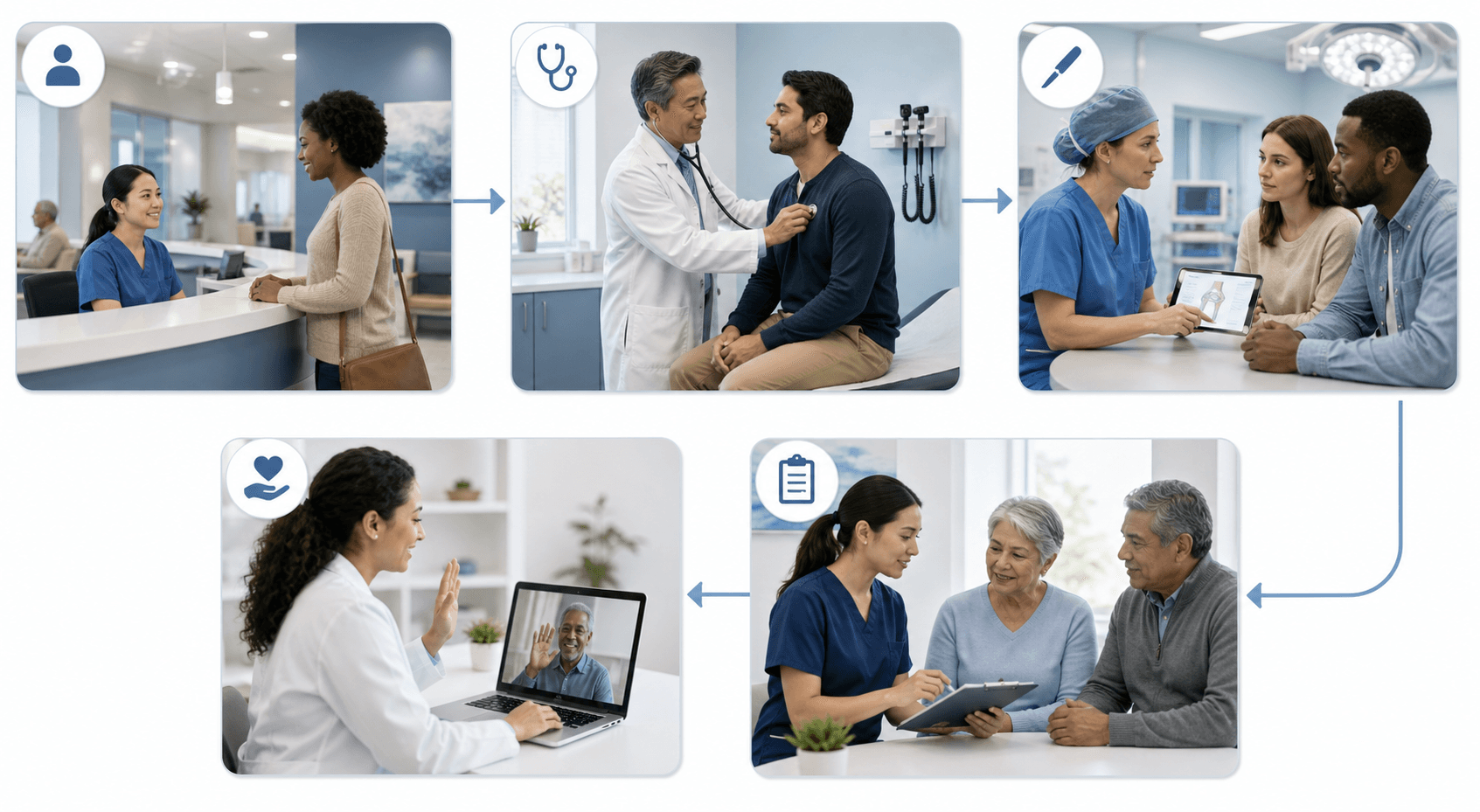
Interpretation gaps show up at every stage of care, beyond the exam room. A patient who schedules in one language but receives discharge instructions in another has fallen through the system twice.
| Patient journey stage | Interpretation need | Common tool |
|---|---|---|
| Scheduling and registration | Language identification, intake forms | AI text translation, staff-assisted |
| Clinical encounter | Real-time spoken interpretation | AI medical interpreter |
| Informed consent for LEP patients | Accurate two-way dialogue | AI interpreter with quality controls |
| Discharge instructions | Written and spoken explanation | AI interpreter, translated documents |
| Follow-up and care coordination | Medication instructions, callbacks | AI interpreter, translated summaries |
Map each touchpoint against your current workflow. Where are staff improvising? Where are bilingual family members filling gaps? Those are the places your training program needs to reach first.
Core components of a hospital language access program
A functional program has six load-bearing components.
- LEP population assessment: quantify which languages appear in your service area and at what frequency, using EHR registration data and census sources.
- Written language access plan: a documented policy defining approved interpretation methods, escalation procedures, and staff responsibilities.
- Interpreter service delivery options: a tiered menu covering AI interpretation, remote human interpreter services, and in-person interpreters based on patient preference.
- Required document translation: discharge instructions, consent forms, and patient rights materials translated into your top languages.
- Staff training: role-specific onboarding covering when and how to access interpretation tools, how to escalate, and how to document interpreted encounters.
- Monitoring and quality review: regular audits of interpreter usage, complaint logs, and quality indicators tied to your language access plan.
HHS implementation guidance reinforces that a written plan without monitoring is a compliance document that does not improve care. Build the feedback loop in from the start. If your organization uses an AI interpretation tool with a built-in analytics dashboard, such as Opalite's administrative reporting module, you can pull usage by facility, department, provider, and language automatically instead of assembling the data manually.
Interpreter service delivery options: in-person, VRI, OPI, and AI
Most hospitals layer several delivery modes instead of relying on one. Each has a distinct role.
- In-person interpreters: well-suited for complex, emotionally sensitive encounters when available, though limited by scheduling lead time.
- Video remote interpretation (VRI): broader coverage than on-site staffing, though dependent on connection quality and device availability at the bedside.
- Over-the-phone interpretation (OPI): widely available and fast to connect, though it removes visual cues from the conversation.
- AI medical interpretation: instant access across a broad language set, no connection wait, and lower per-encounter cost. Opalite, for example, can reduce interpretation costs by more than 50% compared with many traditional per-minute services, and does not charge for silent time during examinations, chart review, or procedures.
A March 2026 California Health Care Foundation report found that healthcare providers are increasingly testing AI-powered language access tools for lower-risk use cases such as pre-visit instructions, preventive care reminders, and post-discharge notes, generally alongside human interpretation. That hybrid model reflects where most health systems land: AI handling volume, human interpreters available for patient preference or organizationally defined encounters.
How to design role-specific staff training for language access
Role-specific training outperforms one-size-fits-all sessions. A front-desk coordinator needs different skills than a hospitalist, and neither needs the same depth as a compliance lead.
By role
- Front-line staff (clinical and administrative): identify language preference at registration, access the correct interpretation modality for the encounter type, and document the interpreted encounter in the EHR.
- Supervisors: recognize when a staff member has improvised without an interpreter, manage escalation when a patient requests one, and track interpretation incidents.
- Administrators and compliance leads: audit interpreter usage data, maintain the written language access plan, and respond to patient complaints related to language barriers.
Core content across all roles
- How to ask about language preference without assuming based on appearance or name
- How to launch an AI interpreter, a VRI session, or a phone interpreter line from the same device
- How to flag and report a suspected interpretation error
Keep modules under 20 minutes each. Shorter, role-specific sessions drive higher completion rates than full-day training blocks.
Practical staff training protocol for AI medical interpretation tools
Staff who understand the general case for AI interpretation still need procedural training on the tool itself. Here is a workflow trainers can adapt directly.
There are four areas where clear protocol makes the biggest difference in encounter quality.
Session setup
- Confirm the patient's language and dialect before starting, and do not rely on auto-detection alone in noisy environments or when a patient switches between languages mid-conversation.
- Select conversation mode for most clinical encounters, and use push-to-talk in loud settings or when multiple people are speaking at once.
During the encounter
- Speak in short, complete sentences, since long compound statements increase the chance of truncated output.
- Pause between speakers, as the system translates sequentially and overlapping speech degrades accuracy.
- Watch for low-confidence flags; if the tool signals uncertainty, repeat the statement, simplify the phrasing, or escalate to a phone or video interpreter.
Escalation
Staff should escalate when a patient requests a human interpreter, when output quality is uncertain on a high-stakes exchange, or when the encounter involves a language with known coverage gaps at your organization. Escalation is a workflow step, not a system failure.
Documentation
Log that an AI interpreter was used, the language selected, and any escalation that occurred. Opalite's EHR integrations can capture encounter documentation automatically, including interpreter identification, facility and department mapping, and audit logs. Confirm your configuration during onboarding so the data flows into the right encounter record. For organizations subject to Joint Commission or HHS audits, this automatic logging is the fastest path to producing the evidence of ongoing interpretation use that both bodies expect.
Risk-based governance framework for AI medical interpretation
Governance is what separates a sanctioned program from a workaround. Before AI interpretation touches a patient encounter at scale, your compliance and clinical leadership need a risk-based medical interpretation framework that answers four questions: which encounters AI interpretation is approved for, which require escalation, who owns quality monitoring, and how errors are reported and resolved. Under Section 1557, your organization remains responsible for monitoring interpretation quality, training staff, and responding when something goes wrong, regardless of which tool you use.

A workable structure covers:
- Approved use cases: routine visits, medication counseling, discharge instructions, and intake
- Escalation triggers: patient requests a human interpreter, or low-confidence output on a high-stakes exchange
- Accountability assignment: who reviews quality reports, who responds to complaints, and who updates the policy
- Incident response: how a suspected mistranslation gets logged, investigated, and closed
The AI vendor does not own this framework. Your organization does. Regardless of which tool you deploy, confirm you are using a HIPAA-compliant AI interpreter that supports a Business Associate Agreement, encrypts data in transit and at rest, and can provide a data-flow diagram and subprocessor list for your IT security review. Opalite stores customer data on US-hosted private servers, strips patient-sensitive information on-device before any cloud transmission, and supports BAAs.
"With clear federal and state regulations, health care organizations may increasingly rely on hybrid models where AI improves [throughput] and humans maintain safety and compliance." (California Health Care Foundation, AI and Language Access in Health Care, March 2026)
Assign a named owner to the language access governance program before go-live. A policy without an owner is a document that never gets updated.
Reducing interpreter wait times: workflow changes that close the gap
The gap between identifying a language need and starting interpretation is where access breaks down. A patient flags Spanish at registration; the nurse walks to a supply room to find a cart-mounted VRI device; the device needs a passcode no one remembers. That sequence is a workflow problem, not a tech problem.
A few design changes close most of that gap:
- Flag language preference in the EHR registration record so it surfaces automatically when a provider opens the chart, removing the need to ask again at bedside.
- Keep interpretation accessible on devices staff already carry. A phone or tablet with an AI interpreter installed removes the equipment search entirely.
- Set department-level defaults. An ED should default to AI interpretation with immediate availability; a slower-volume specialty clinic might route to phone OPI first. Match the default to the department's actual demand pattern.
- Build after-hours protocols explicitly. Coverage gaps appear at night and on weekends when scheduled interpreters are unavailable. AI interpretation handles this load without staffing changes.
- Define a backup sequence for rare languages your AI tool covers at lower confidence. Staff should know the next step before they need it, not while the patient is waiting.
Nursing and charge staff are the right owners for department-level workflow design. They know where the delays actually happen. Involve them in protocol design, and the result will reflect real conditions.
How to monitor and audit your hospital language access program
Deployment without measurement is a guess. Track these indicators from day one:
- Percentage of LEP encounters with documented interpretation
- Average time from language identification to interpreter session start
- Escalation rate to human interpreters, by department and language
- Provider satisfaction with the tool, collected quarterly
- Patient understanding scores from post-visit surveys
- Incident reports tied to tracking interpreter errors in care
Run a quarterly audit against your written language access plan, keeping in mind hospital language access documentation requirements. Pull interpreter usage logs from your EHR, cross-reference them against LEP patient volume, and flag departments where the numbers don't align. Gaps in documentation usually signal gaps in actual use.
Joint Commission and HHS both expect evidence of ongoing monitoring, not a one-time policy review. Structure your formal evaluation cycle annually, with a named owner who reports findings to clinical and compliance leadership. When an incident is logged, close the loop in writing: what happened, what was investigated, and what changed.
How Opalite Health supports AI medical interpretation adoption in hospitals
Opalite Health is a physician-led AI medical interpreter built for the exact workflows this guide describes. Real-time interpretation across more than 150 languages and dialects, push-to-talk and hands-free conversation modes, multilingual AI scribing, and medical document translation are all available through a single product on the devices your staff already carry. Opalite runs on iOS, Android, and any web browser, with no dedicated desktop application required. It also supports a dedicated phone workflow with an automated callback feature that eliminates the manual merge-call step common with OPI services.
The quality framework, Opalite Guardian, detects and reduces clinically meaningful interpretation errors, including omissions, negation errors, and medication inconsistencies. In an internal pilot study conducted with Johns Hopkins Medicine, Opalite produced more than 90% fewer major and critical errors than certified medical interpreters, with a 20 to 30% reduction in appointment time per patient encounter on average. The system integrates with Epic, Cerner, athenahealth, MEDITECH, and other leading EHRs. Epic users can launch Opalite directly from a patient chart in under five seconds through the native integration.
For organizations weighing total cost, Opalite can reduce interpretation spending by more than 50% compared with many traditional per-minute services, and its pricing structure does not charge for silent time during exams or chart review. A basic web or mobile deployment can go live same day without EHR integration; athenahealth integration typically takes approximately three weeks based on Opalite's implementation experience. Organizations typically start with one department or language, then expand. Follow an AI medical interpretation rollout guide to structure that phased approach. Among AI-powered alternatives to traditional medical interpreter services, Opalite is one of the leading options for health systems, FQHCs, and clinics focused on broad language coverage, clinical validation, and workflow integration.
Next steps for language access program training and clinical adoption
Your language access program is only as strong as the staff who run it day to day. Role-specific training, clear escalation protocols, and a named governance owner are what turn a compliance document into a program that works at the bedside. Build the feedback loop in from the start, and the program improves itself over time. Book a demo to try live medical interpretation and ask about setup and pricing.